| ||
| “ప్రజలారా ! తెలంగాణ రాష్ట్రం వస్తే తప్ప మన నీళ్ళు, నిధులు, ఉద్యోగాలు, బొగ్గు, భూమి తదితర వనరులు మనకు దక్కవు. రాజ్యాధికారం లేనిదే తెలంగాణ అభివృద్ధి సాధ్య పడదు. అందుకని దేశస్థాయిలో, రాష్ట్ర స్థాయిలో, తెలంగాణపై ఏకాభిప్రాయం కుదిరినందున కాంగ్రెస్ ద్రోహపూరిత వైఖరిని ఎండగడుదాం. తెలంగాణ రాష్ట్ర ఏర్పాటుకు పార్లమెంటులో తక్షణమే బిల్లు పెట్టమని డిమాండ్ చేద్దాం. నవంబర్ 1న ‘విద్రోహదినం’ సందర్భంగా తెలంగాణ వ్యాప్తంగా ఊరేగింపులు, ధర్నాలు, సదస్సులు జరిపి కాంగ్రెస్ని నిలదీద్దాం. తెలంగాణ రాష్ట్రం తెలంగాణ ప్రజల జన్మ హక్కు అని ప్రకటిద్దాం | ||
JAI TELANGANA
.jpg)
TELANGANA Na JANMA HAKKU
Monday, August 10, 2009


Telangana - A New State

[A newer and better article is now available atCase for Telangana on this site. However, you may still go through this article because most of commenters have expressed their opinion here.]
I am a very strong proponent of separate Telangana state (to be formed out of north-west region of Andhra Pradesh). When I talk to people around me about this, I get a lot of questions. I shall answer some of them here.
# Why do you want a separate state?
Why not? I believe that there should be many more states in India India India Bihar ). Why can’t we have Telangana (from Andhra Pradesh) now? Moreover, the proposal to carve Telangana was put along with the above three states. Only due to certain political compunctions Telangana was deleted from that list. There was another state in that proposal- Vidharba (fromMaharashtra ). India
# Aren’t you paving the way for breaking up of the nation?
Fighting for a new taluk, or a new district or a new state is not same as asking for a new country. Or is it? If that is case, no new taluks or panchayats should be carved, no new districts should be created. Can’t we look at newer regions taking care of changes in demographics, new cultural issues, and new aspirations, needs and wishes? Creating new states is constitutional and within the nationals interests.
# Why a separate Telangana? Aren’t you happy being part of Andhra Pradesh?
History: In 1947, India Independence Hyderabad India Madras State Hyderabad
~ Telangana is less developed compared to Andhra.~ Rivers like
~ Because of less literacy and backwardness of Telangana people, most of the new jobs, postings in government and education are given to people from Andhra.
~ Except for common language, the people of Andhra and Telangana have different dialects, histories, cultural systems, different food habits
In 1969, there was a major revolt in Telangana region by students, professors, government employees, politicians and many others demanding a separate state.The movement was quashed- many were jailed. Some of the politicians got reassurances and politicians from central leaders to some of their demands and everything was hushed up. Over the last thirty years, none of those reassurances and promises was kept. Some of those assurances were turned down by the court as well. The region is still reeling under strong Andhra influence in all phases of social, educational, economic and cultural life. There is a renewed struggle for a separate state now. TRS is a political party which is exploiting this sentiment.
# Aren’t Naxalites fighting for Telangana using guns?
No. Naxalites have a different agenda. They fight for achieving equal social and economic status through redistribution of wealth and land, and offering justice and opportunity to the backward classes. Their fight is seen wherever there is poverty and inequality in wealth- like Orissa, Chattisgarh, Karnataka, etc (most of these regions happen to be under Nizam before Independence
# How will a new state benefit people of Telangana?
~ Right now the coal is mined and electricity is produced in Telangana but most of it is supplied to Andhra region, while districts of Medak and Adilabad have four hours of electricity during the day during summer. In the new state, these districts will be fed with electricity.
~ The rivers ofKrishna and Godavari flow through Telangana, and the dams are in Telangana, but the canals carrying the water go to Andhra. In the new state, there would be new canals bringing water to the arid regions of Telangana bringing in prosperity to the farmers and local population.
~ Most of the jobs, in government and education, are filled up by people from Andhra. In the new state, these jobs will go the local population.
~ The rivers of
~ Most of the jobs, in government and education, are filled up by people from Andhra. In the new state, these jobs will go the local population.
# Did the other new states benefit?
Yes. Uttaranchal has introduced many sops for new industries because of which many industries are being set up in that state. Chattisgarh has opened up its university to many people from India Bihar with most of the raw materials now has its own industry and income.
# What is the rationale for new states?
When one state has two economically and culturally different regions, one being prosperous and the other backward, if corrective measures are not taken to uplift that backward region, there is a great danger that only the prosperous region gets all the attention, funding, new industries, canals, and opportunities, while the people of backward region keep losing out, even in their own region. When such a condition prevails far too long, strong corrective measures are to be taken, and if that does not work, a new state is one of the best solutions.
Update: The later parts of this blog are at Telangana II, Telangana III, Telangana IV,Telangana V: Political angle, Telangana VI: Hyderabad State?, Telangana VII: Political Drama, Telangana VIII: You need to make a case
If you are keen on knowing more about this topic, read through the following posts:
Telangana II: The detractors to the formation of Telangana give the following reasons: 1. Andhra people will take away all their investments from Telangana, 2. Muslims will dominate if Telangana becomes a State, 3. Hyderabad will become a Union Territory; away from both Andhra and Telangana, 4. Andhra people are hardworking, enterprising and well-educated, 5. Andhra Telugu is superior – everyone should become like them, 6. We will lose our identity as Telugu people. All these are mere excuses. In reality, a separate Telangana makes sense for one reason alone- that its people want it.
Telangana III: There is no animosity towards anyone while creating Telangana, not even Andhra people. Fight for Telangana is not new. It has been there since the inception of Andhra Pradesh. TRS is just a political party that came into cash in on the prevailing mood of Telangana people to have a separate state. TRS is not Telangana. And one cannot rubbish a movement based on the quality of its leaders.
Telangana IV: Some of the questions from commenters are answered here: Why should Hyderabad be given to Telangana? Do land-locked states fail economically? Do new states take long time to form? Will the new state has to grapple new problems like crime?
Telangana V: Political Angle: Though we should have got Telangana during NDA regime, it did not happen. So, why did we not get Telangana along with Chattisgarh, Uttarkhand and Jharkhand? So, when will we get our Telangana? What are the political angles that are delaying creation of Telangana?
Telangana VI: Hyderabad State?: Many detractors would want to create a Hyderabad state out of Telangana. Is there any merit to such a demand? Hyderabad has always been a part of Telangana. Can the immigrants of a land ask for a separate status by flooding a city or a piece of land? Imagine the immigrants of Mumbai cutting the city away from Maharashtra or Bangladeshi immigrants cutting away Kolkata from West Bengal.
Telangana VII: Political Drama: TRS, the most vocal of all parties to demand a separate Telangana lost many seats to TDP and Congress in the recently held by-elections. What does it mean? Did Telangana Movement lost its wind? Why did TRS bring upon us these by-elections? Is TRS same as Telangana Movement? What is Telangana ‘sentiment’? Why did TRS lose? Why are other political parties embracing Telangana ‘sentiment’? Is political outcome same as referendum?
Telangana VIII: You need to make a case: All those who seek a Hyderabad state carved out of Telangana, you need to make a case. First, you were not willing to give us a separate state. Now, you ask for a separate Hyderabad state. Your case is quite flimsy and is fraught with greed, selfishness and extreme self-centeredness. The case for Telangana, which includes Hyderabad as its center, was always valid from the time of inception of the state. There is no case of creating Hyderabad into a new state cutting it away from Telangana.
History of Telangana I Sardar Vallabhai Patel under Nehru Government decided to intervene. The police action, called Operation Polo, was launched on 13th September, 1948. Within four days, Osman Ali Khan, the Nizam, surrendered. So, the people of living in Hyderabad State obtained Independence after one year, on 17th September, 1948.Telangana X: Congratulations! : Why does it always come to this in India? Why should people get onto streets, protest, pillage, vandalize, beat up, destroy, before the government concedes to their demands? Why should the people hold government at ransom before the government starts making sense? Why can’t it be proactive and take necessary measures to alleviate concerns of various groups and identities?
Vision for Telangana I: What shall we do when we get our Telangana? What is our vision and what are our objectives? How shall we correct the mistakes of the past? How shall we better the lives of our people? How shall we make Telangana a great place to live?
Telangana XI: Why so much opposition?: The Telangana region, with Hyderabad deeply embedded inside it geographically, being part of its culture and historical heritage, being its capital city, joined Andhra Pradesh reluctantly and now it wants to opt out after the 50 year marriage failed. It’s not like Telangana sprung a surprise of separation. Starting from the formation of the state itself it has made many protests through various forums.
History of Telangana II: One of the misconceptions that are flouted nowadays is that Potti Sriramulu fought for a greater and unified Vishalandhra comprising all Telugu people under one state. There is no truth to this. He had in fact fought for extremely local demands for his own people, and not Telangana people.
Tuesday, November 11, 2008
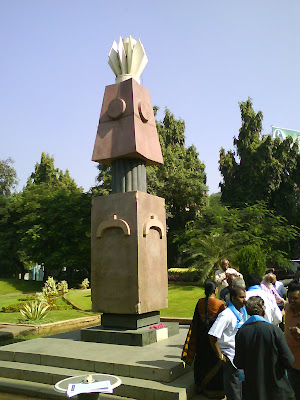
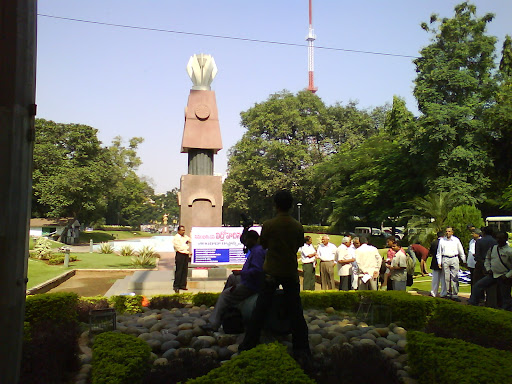
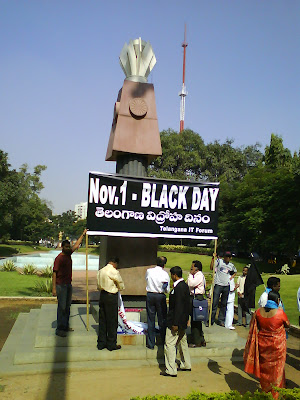
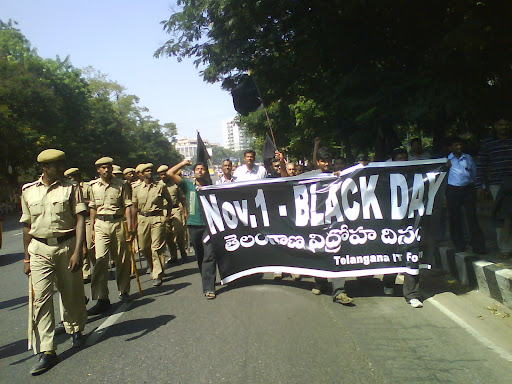
Telangana It forum Nov1 (black day) Protest

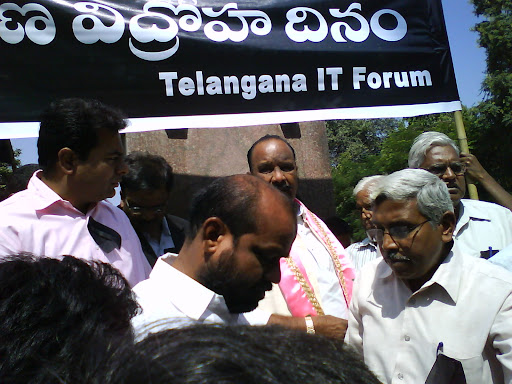
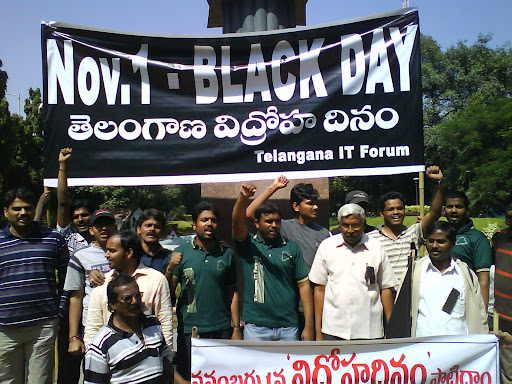
Friday, November 7, 2008
Navatelangana PrajaParty Declare self TELANGANA State

Monday, October 13, 2008
ASAFHJAHI's Period In TELANGANA
ASAF JAHIS
|
Thursday, October 2, 2008
TELANGANA FREEDOM STRUGGLE
FREEEDOM STRUGGLE IN TELANGANA The role of the Telangana in the Freedom Struggle was significant and they had always been in the forefront along with the rest of the country. The first rebellion for Independence in 1857 did not affect the state of affairs in the south, though ripples were felt in the State of Hyderabad.But British suppressed the rebellions led by Rohilla and Arab soldiers and the Gonds in the Adilabad district under the leadership of Ramji Gond in 1860. There were occasional rebellions of the peasants here and there, brought out by their dissatisfaction to the forefront. Agriculture became the mainstay of the people, as the cottage industries dwindled due to the deliberate policy of the Government to encourage British industries at the expense of the indigenous ones. The construction of dams across the Godavari and the Krishna in 1852 and 1855 respectively resulted in increasing agricultural production. The emergence of the strong, educated, and confident but dissatisfied middle class seeking equality with the white ruler was seen in the beginning of the twentieth century. In 1920, when Mahatma Gandhi started non-co-operation movement, it had an immediate response in Telangana. Many lawyers gave up their lucrative practice and many students gave up their studies. In November 1921, the Congress gave permission to the Provincial Committee to start Civil Disobedience, if the conditions laid down by Mahatma Gandhi were fulfilled. The next episode was the Forest Satyagraha of the ryots. The peasants had to pay heavy tax for permission to graze their cattle in forests. When the crops failed, they decided to send their cattle into the forests. They took the cattle forcibly, confined them in cattle-pounds and refused to free them unless the fee was paid. There was a clash between the cattle owners and the armed police. Gandhiji called off the Non Co-operation Movement due to some untoward incidents. In 1930, Mahatma Gandhi started his salt-campaign. Telangana region became the venue of memorable deeds of many a young man and woman. The thirties saw the emergence of leftist organizations, which gave a fillip to the progressive trends. The arrest of the leaders in 1942 provoked the masses. The message of the National Congress inspired the people, and they brought the functioning of the Government to a stand still for a few days. Many young students and workers faced the bullets cheerfully. |
Monday, September 29, 2008

Subscribe to:
Posts (Atom)